WHITE PAPER
Water Submetering: 8 Factors to Consider for New-Construction Multifamily Properties
A guide for Mechanical, Electrical & Plumbing (MEP) contractors.
For multifamily construction projects, water submetering isn’t an afterthought. It’s a key step toward delivering high-quality buildings that are safe and inviting for residents—and financially and operationally sound for owners and managers through accurate billing. And, of course, per-unit submetering is mandated in many states and municipalities.
Multifamily insurance costs are rising 26% year-on-year—and water damage is the #1 risk factor, impacting more than 70% of operators. That’s especially true for new, high-density construction projects: when you go vertical, unnoticed leaks can cause damage on multiple floors, quickly leading to sky-high remediation costs.
Effective submetering dramatically reduces those risks, enabling rapid leak detection and more efficient and equitable water management.
But not all submeters are born equal—and picking the wrong equipment can prove an expensive mistake.
Here are the top factors to look for when choosing submeters for a multifamily project:
- Accurate, utility-grade equipment. The market is flooded with cheap imported meters that typically record 80% or less of the water that flows through them. That means water costs aren’t recaptured, driving up operational costs for the finished property—and it also makes advanced leak detection virtually impossible.
Action item: Ensure devices meet or exceed AWWA C712 (mechanical) or AWWA C715 (ultrasonic) design and performance specifications, and are also NSF-61G lead-free certified. - Low-flow technology. Modern metering can detect small leaks anywhere in a multifamily property, and even differentiate pinhole leaks from dripping taps, allowing minor issues to be found and fixed before they evolve into major headaches. That’s only possible, though, if each submeter is capable of detecting tiny variations in flow rate.
Action item: For pervasive leak detection, ensure submeters can detect flow rates as low as 0.06 gallons per minute. - High-resolution data. Leak detection is only possible if meters capture data almost continuously, enabling variations to be quickly spotted and revealing the telltale fingerprints of leaks compared to normal variations in water consumption. They also need to report any abnormal flow immediately, to ensure issues are quickly fixed.
Action item: Ensure meters capture data at least every 60 seconds, and immediately send alerts via text or email if they detect abnormal flow. -
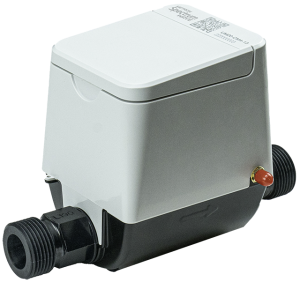
Metron Spectrum® Wave ultrasonic water meter Flexible installation. Some submeters are very sensitive to nonstandard installation—if a mechanical meter is installed sideways, for instance, up to 30% of water flow can go unrecorded. The best meters offer true install-anywhere capabilities, with long-life battery and fully wired options, and no restrictions on orientation.
Action item: Look for digital submeters that can be easily installed in any orientation without degrading performance. - Cellular connectivity. Too many submeters rely on expensive RF infrastructure or unreliable Wi-Fi connections to transmit the data they collect. Best-in-class equipment
comes with built-in cellular connectivity, ensuring data collection never becomes an operational headache or an unexpected additional expense for end-users.
Action item: For dependable data collection across a device’s full lifespan, demand cellular connectivity backed by a major national service provider. - Data that works for you. Submetering should make life easier, not harder. Meters should come with intuitive back-end software and data portal that integrates
seamlessly with third-party management systems. It should also provide automatic alerts, with no need to sift through columns of numbers to get key insights.
Action item: Look for free-to-use, properly supported software designed to integrate with billing tools and other back-office systems. - Tools for tenants. Submetering isn’t just good for owners and property managers – it can also streamline tenant relations by helping residents to understand their water use and make better decisions. To support that, vendors must provide dedicated customer-facing software that lets tenants set up alerts and check water consumption.
Action item: Look for vendors who truly understand residents’ needs, and provide dedicated, user-friendly data portals. - Customer support. Not all meter vendors provide timely customer support with proven satisfaction ratings. If problems arise, it’s important to access help quickly, including warranty and replacement parts.
Action item: Look for vendors with a proven track record of responsive and committed customer support.
The bottom line: when you install a submeter, you’re making a decision that will determine how managers and tenants handle water issues for years to come.
That means it’s important to think carefully about the equipment you install. Contractors need to provide devices with accuracy and staying power, capable of delivering the high-quality data and reliable connectivity needed to maximize recapture rates and enable near-instant leak detection.
But they also need to ensure their vendors are committed to supporting multifamily properties and providing hands-on customer support—not just during installation, but across the full lifespan of their equipment.
Want to find out more about modern submetering technologies for new-construction multifamily projects? Get in touch with the Metron team today.